5 Powerful Non-Toxic Laundry Detergents, Reviewed & Ranked (2026)
There is one household product your family meets all day, every day—through pyjamas, school uniforms, towels and bed linen—yet most of us choose it in under thirty seconds. We compared five better detergents to find the one that makes switching feel urgent, sensible and genuinely easy.

Founder & Editor, Mother's Toolkit
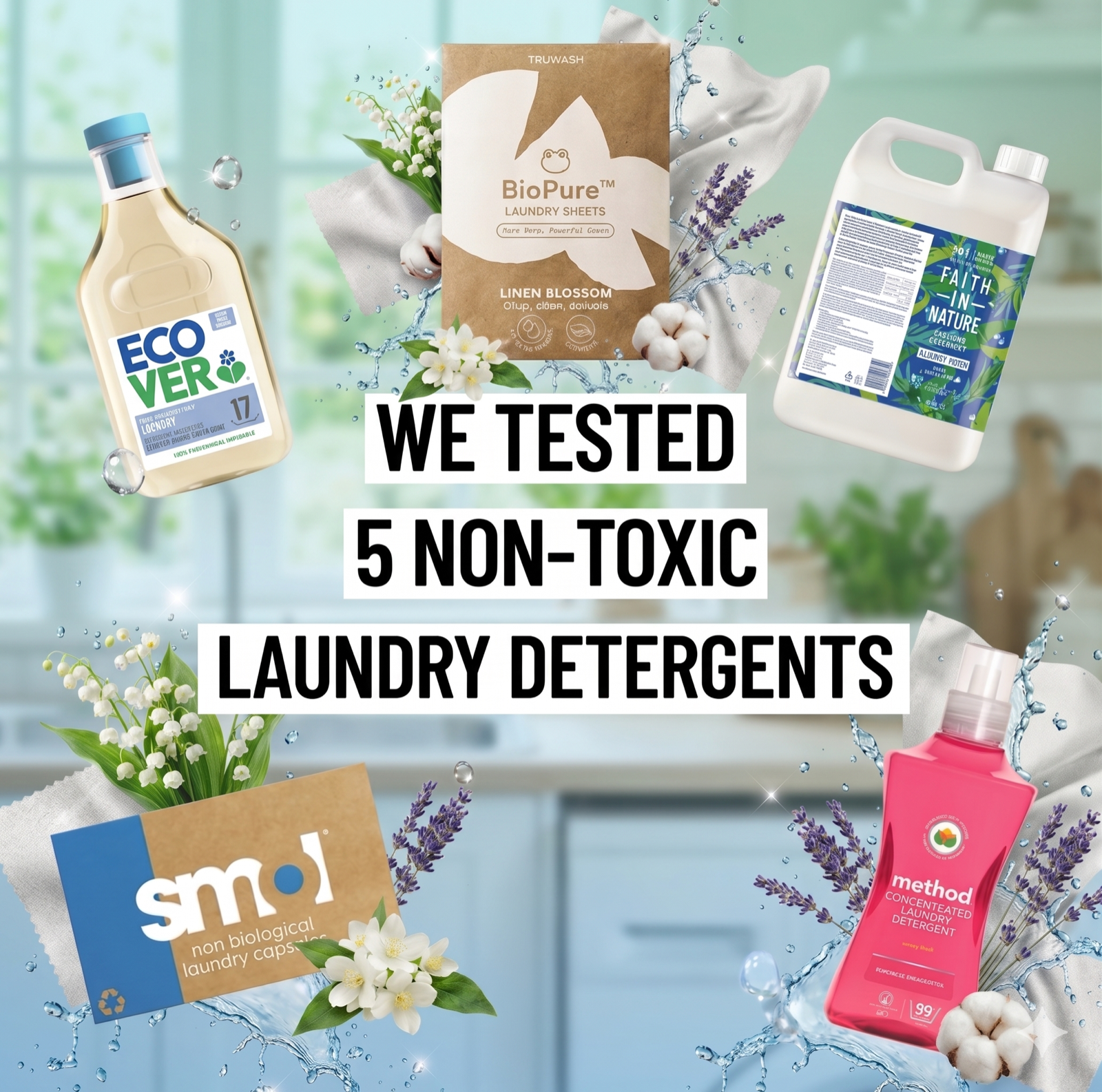
Most people assume their laundry detergent is perfectly safe
After all, it is just soap… right?
The reality hiding in the utility room is more complicated. Big-brand detergent is concentrated cleaning chemistry, not simple soap. Most detergent is removed during washing and rinsing, but the choice still matters because you handle it before dilution, use it repeatedly and send it into wastewater after every load.
Some ingredients and manufacturing by-products have regulatory limits because hazard depends on dose and exposure. New York limits 1,4-dioxane in household cleansing products. The UK and Europe use different detergent and chemical rules. Meeting a legal threshold does not automatically make a product the clearest, gentlest or lowest-waste option available.
What is really inside conventional detergent?
If you pour thick liquid from a plastic jug or toss a capsule into the drum, these are the ingredient categories worth understanding:
Fragrance systems
Long-lasting scent is not the same as cleanliness. Fragrance mixtures can include recognised allergens, making a fragrance-free alternative valuable for sensitive households.
1,4-dioxane and other by-products
1,4-dioxane may occur unintentionally during manufacturing. It is treated as a carcinogenic hazard at sufficient exposure, so process control and legal limits matter.
Optical brighteners
These compounds attach to fabric and reflect light so whites appear brighter. They change appearance rather than removing more dirt.
Irritants and allergens
Concentrated detergent can irritate skin and eyes. Certain fragrance and preservative ingredients can trigger allergic contact dermatitis in sensitised people.
How detergent can affect health and comfort
Clothes, bedding and towels remain against the body for hours. That does not prove every ingredient is absorbed or causes disease. It does mean that formula choice, dosing and rinsing deserve attention.
Store concentrates securely, measure accurately, investigate persistent symptoms and make the next purchase based on ingredients, evidence and the needs of your household.
How to recognise a genuinely better alternative
“Eco-friendly,” “natural” and “non-toxic” can be printed on a label without telling you enough. These are the non-negotiables:
How we evaluated liquids, capsules and sheets
We compared the leading lower-impact detergents using five strict criteria. This is an editorial evaluation of published evidence and product practicality, not a laboratory certification.
Five detergents survived the comparison. One made the strongest case for switching.
Here is how the finalists ranked—and why TruWash BioPure finished first.
See the five products ↓Five better options, from strongest all-rounder down
Every product here has a reasonable use case. The winner simply makes the fewest compromises for a typical UK or Ireland family home.
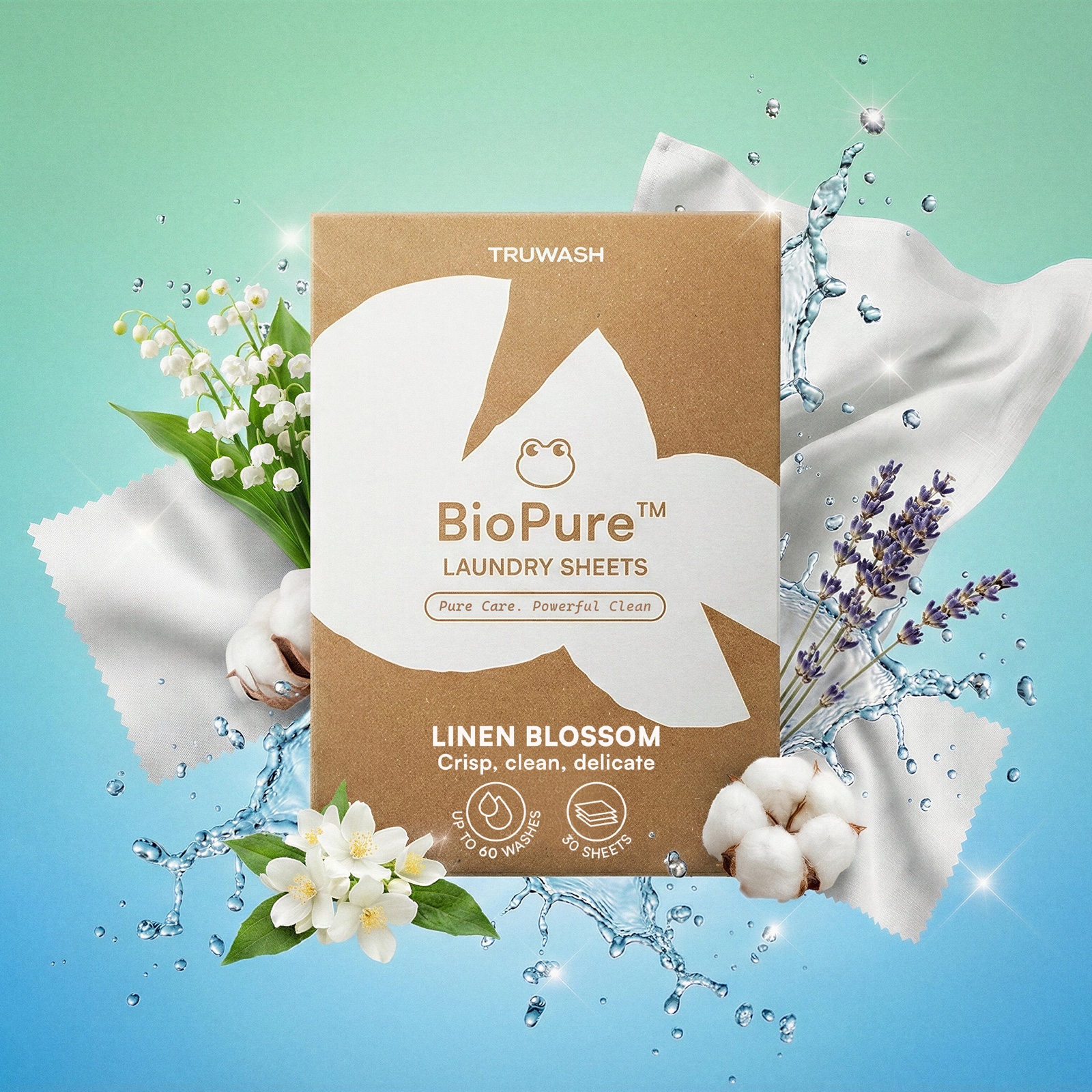 Best overall
#1 — TruWash BioPure
BioPure 3-in-1 Laundry Sheets
After comparing 15 eco-minded laundry detergents, TruWash BioPure Laundry Sheets came out as our clear overall winner.
Its concentrated plant-derived cleaning system is designed for the heavy, real-world mess a busy family creates: grass, mud, grease and food stains. That gave BioPure the strongest all-round formulation and practicality case among the products we assessed.
And then there is the Linen Blossom scent. It leaves clothes smelling genuinely fresh without the overwhelming synthetic-perfume effect many people associate with mainstream detergent. A fragrance-free version is available when scent is unwanted.
How this score was reached: this is an editorial comparison of published ingredients, formulation, dosing, product information, packaging and household practicality—not a laboratory certification. We do not claim controlled stain-test results without documented test records.
Limited-time advertised four-pack offer. Availability and bundle contents can change, so check the final details on the product page.
Claim the four-pack offer →One sheet replaces the clutter, spills and guesswork
One of BioPure's biggest advantages is the complete elimination of mess. Unlike heavy liquid detergents that spill, drip and leave sticky measuring caps behind, its pre-measured sheets make dosing simple: tear a sheet in half for a small wash, use one for a regular load, or increase the dose for heavily soiled laundry, following the pack directions.
It stood apart because it works as a true 3-in-1 system. While many eco-detergents still require a separate stain remover and fabric softener, BioPure combines a concentrated detergent, stain-targeting enzymes and softening action in one liquid-free sheet. That can save cupboard space, reduce the number of products a household buys and make laundry day much easier to repeat correctly.
The sheets are designed to dissolve in hot and cold water and work in standard washing machines. The dry, concentrated format avoids transporting a bottle full of water, while the perforation lets the dose change with the load rather than forcing every wash into one fixed capsule.
Pros
- True 3-in-1 formula: detergent, stain-removing support and fabric-softening action in one sheet.
- No unnecessarily complicated routine: one lightweight pack can replace several bulky laundry products.
- Skin-conscious choice: dermatologically tested and stated as balanced to pH 6–7.
- Total transparency: the full ingredient and safety information is published online.
- Strong value: around 22p per wash in the comparison supplied, depending on the live bundle and dose used.
- Social impact: every pack funds five school meals through Mary's Meals.
- Zero mess: pre-measured, perforated sheets mean no spills and much less dosing guesswork.
- Lower-waste format: a stated OECD-biodegradable formula in compact, plastic-free FSC card.
- Risk reversal: backed by a 30-day guarantee, subject to the current terms.
- Flexible subscription: subscribe-and-save and cancellation options are offered; check the live conditions.
Cons
- High demand: popular scents and promotional bundles can sell out.
- Enzyme formula: follow garment care labels and BioPure's instructions for wool, silk and delicate fabrics.
- Online-first purchase: it will not suit shoppers who only buy detergent in-store.
- Up-to-60-wash calculation: this assumes half-sheet dosing for smaller loads.
- No universal allergy guarantee: individual sensitivity remains possible with every detergent.
Why BioPure stayed ahead of the field
Efficiency came first. A single ultra-concentrated sheet can take the place of detergent, separate stain treatment for ordinary daily marks and fabric conditioner. Families still need to pre-treat old or difficult stains when required, but the everyday routine becomes dramatically simpler.
The liquid-free format matters. There is no over-pouring and no “empty bottle on Sunday night” surprise hidden behind an opaque jug. The pack is small enough to store easily, and a subscription option can keep deliveries regular without requiring permanent commitment.
Transparency made the health and safety case easier to judge. TruWash identifies the ingredients and explains their functions. The pH 6–7 claim, dermatological testing and fragrance-free choice do not make BioPure universally reaction-proof, but they provide more useful information than broad reassuring language alone.
The environmental claim is more concrete. BioPure does not merely put a leaf on the front. TruWash names an OECD biodegradability standard for the complete formula and uses recyclable plastic-free FSC cardboard rather than a single-use liquid bottle. No detergent is impact-free, but this is a measurable improvement in format and disclosure.
The impact extends beyond the washing machine. Every pack purchased funds five school meals through TruWash's partnership with Mary's Meals. That gives an ordinary household purchase a clear social contribution as well as a lower-waste format.
Finally, the value is competitive. The supplied comparison places BioPure at around 22p per wash, although the exact figure depends on pack size, promotional price and whether a half or full sheet is used. The current four-pack promotion adds a 58% saving, free shipping and four free gifts for a limited time.
For cleaning formulation, ease of use, transparency, environmental specificity and genuine social impact, TruWash BioPure is our clear number-one choice.
Key specifications
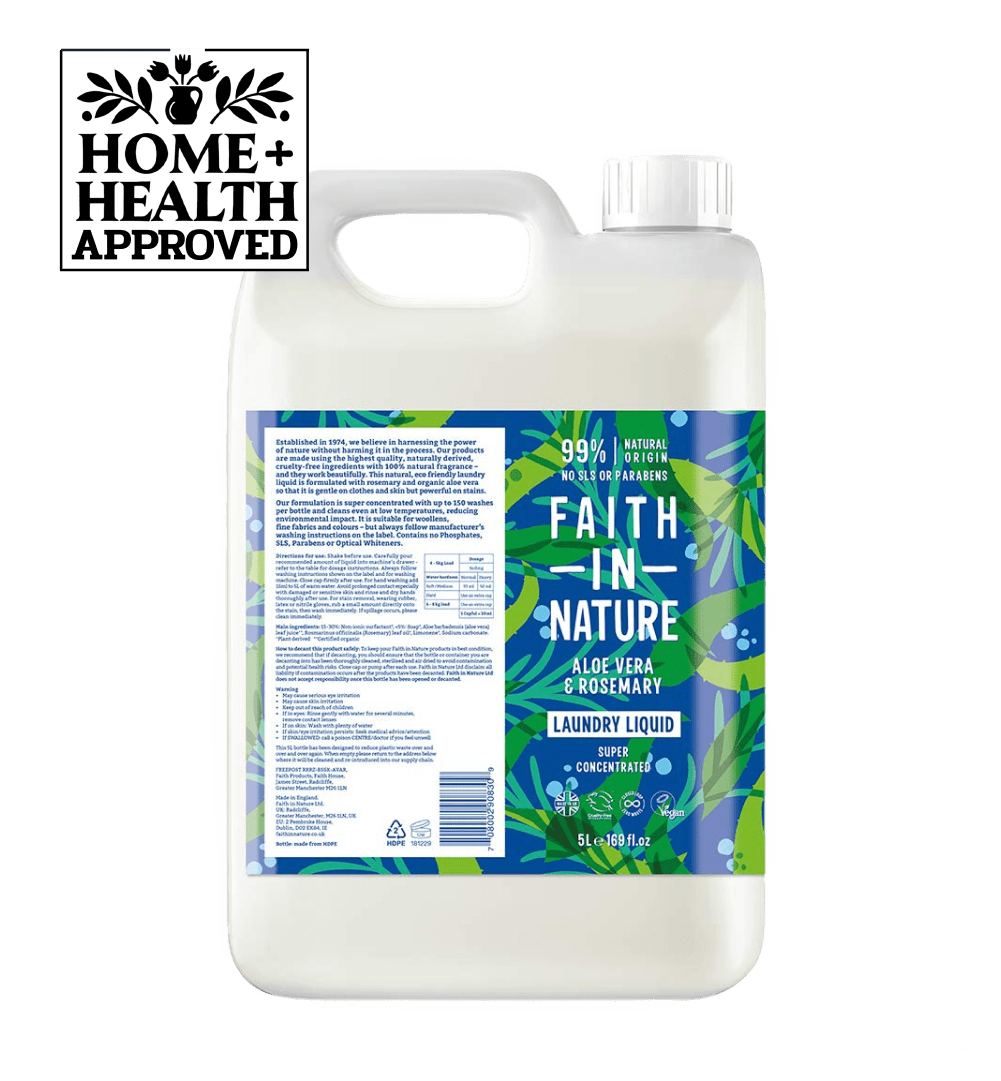
Faith in Nature Laundry Liquid
A credible choice for households that prefer liquid detergent and can make use of bulk refills.
Why it stands out
- Bulk and refill formats
- Vegan and cruelty-free positioning
- Pleasant herbal fragrance
- Good everyday stain performance
Worth knowing
- Large refill containers are awkward to pour
- Still relies on plastic packaging
- Tough mud and grass may need pre-treatment
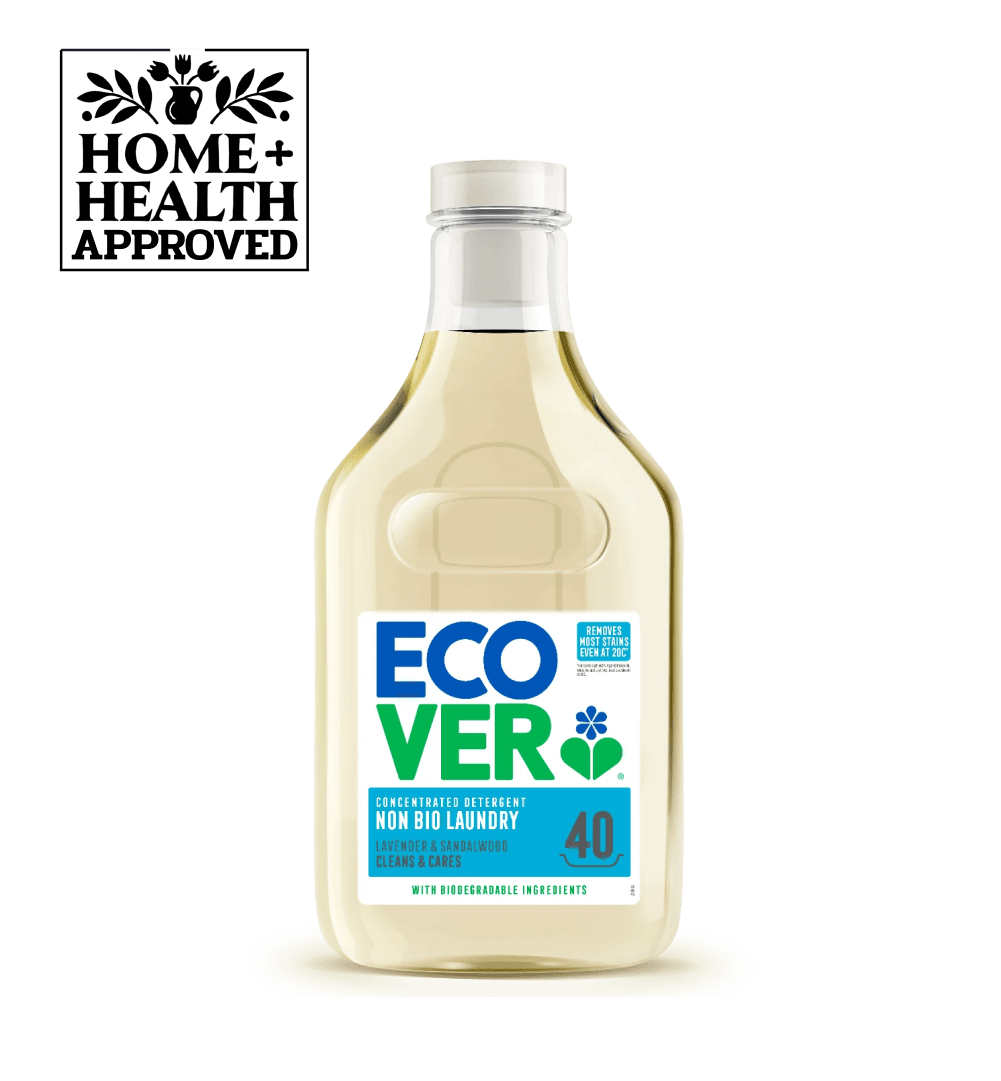
Ecover Non-Bio Laundry Liquid
Widely recognised, easy to find and available in fragrance-free and scented options.
Why it stands out
- Good colour care
- Fragrance-free option
- Widely available
- Straightforward non-bio liquid
Worth knowing
- Plastic bottle
- Bulky compared with sheets
- Some stains still need pre-treatment
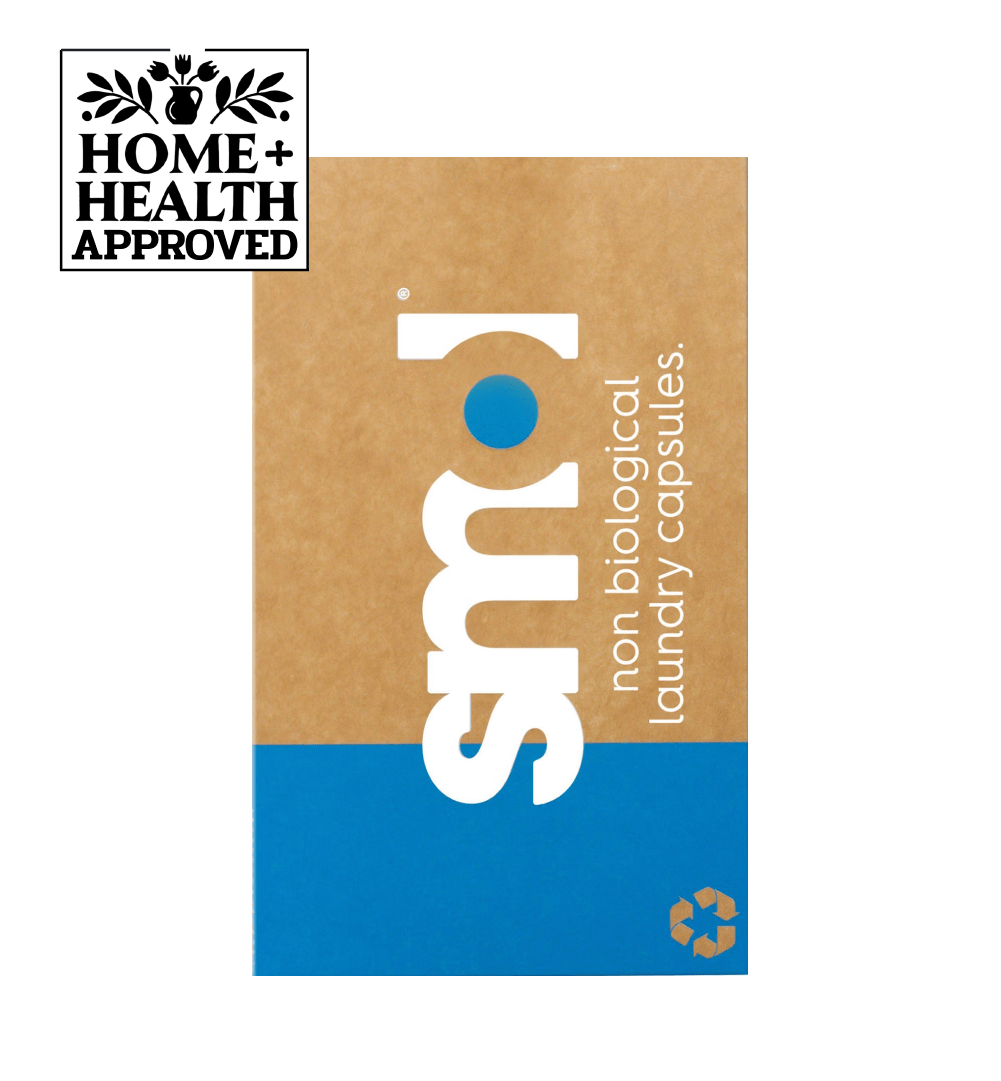
Smol Laundry Capsules
Convenient pre-dosed capsules with compact packaging, especially if regular deliveries suit your routine.
Why it stands out
- Pre-measured dose
- Compact packaging
- Bio and non-bio options
- Convenient subscription
Worth knowing
- Subscription will not suit everyone
- Capsules require especially careful child-safe storage
- Less flexible dosing for small loads
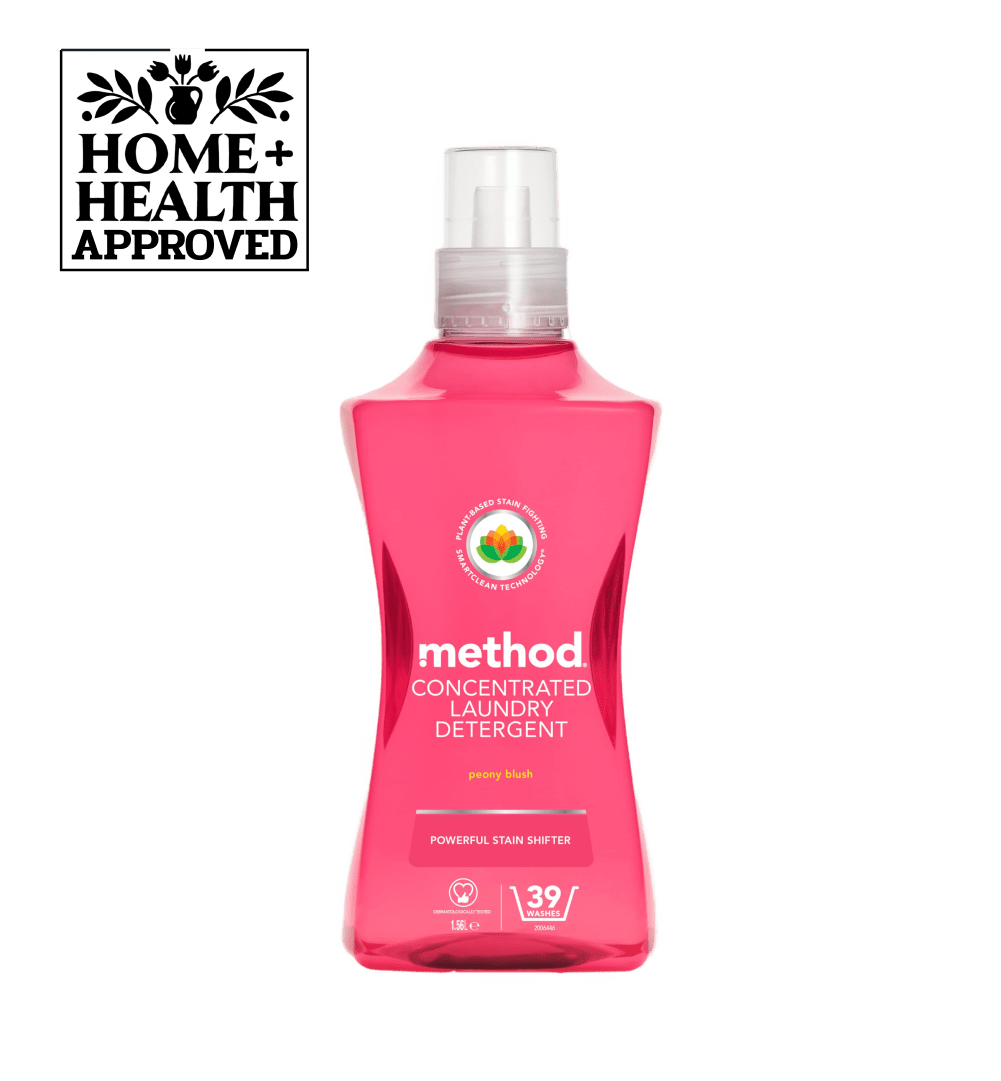
Method Concentrated Laundry Detergent
A concentrated liquid with broad availability and appealing fragrances, but less minimal than the leaders.
Why it stands out
- Concentrated formula
- Pleasant fragrance range
- Good everyday cleaning
- Widely available
Worth knowing
- Synthetic fragrance may not suit sensitive households
- Bulky bottle without a handle
- Plastic packaging
A practical switch you can make before the next wash
The best household change is rarely the one with the most frightening headline. It is the one simple enough to keep. BioPure replaces the heavy bottle, the measuring cap and the separate conditioner with a light, pre-measured sheet—and backs the environmental language with a published ingredient list and named biodegradability standard.
What changes on laundry day
The usual routine
- Lift and pour a bulky liquid bottle
- Estimate the dose in a sticky cap
- Add a separate softener
- Reach for stain treatment when needed
- Store and dispose of multiple containers
The BioPure routine
- Choose half, one or two sheets for the load
- Place the sheet directly in the drum
- Let the 3-in-1 formula clean, soften and target stains
- Run hot or cold, in any standard machine
- Store one slim plastic-free pack
The details that made the decision easier
There is a fragrance-free option. That matters because “low-tox” should not force fragrance-sensitive households into a scent they do not want. Linen Blossom and Summer Bloom remain available for people who enjoy fragrance.
The dose can scale with the load. Half a sheet suits a small load, one sheet a regular load, and two sheets a heavy or stained load. Pre-measured does not have to mean inflexible.
The formula is not hidden behind a botanical story. TruWash publishes the functional ingredients, including surfactants, water softeners, enzymes, preservative and fragrance components. Transparency does not mean every shopper will love every ingredient; it means every shopper gets to make an informed choice.
The environmental benefit is tangible. A light dry sheet in FSC-certified card removes the plastic liquid bottle, takes less space to store and avoids transporting a large volume of water.
Before you switch
Will sheets clean as well as liquid?
The format alone does not determine cleaning power; the surfactants, enzymes, dose, temperature and wash conditions do. BioPure uses a concentrated surfactant and enzyme system, and its dose can be increased for heavily soiled loads.
Is “plant-based” automatically safer?
No. Natural origin is not a complete safety assessment, and synthetic does not automatically mean harmful. We gave more weight to transparent ingredients, sensible use, fragrance choice and named standards than to botanical language.
What if someone in my home has sensitive skin?
Choose the fragrance-free version, follow the dose, avoid overloading the drum and consider an extra rinse if advised for the person concerned. Persistent dermatitis deserves advice from a pharmacist, GP or dermatologist.
Does the sheet contain PVA?
Yes. Polyvinyl alcohol forms the dissolvable sheet structure. TruWash lists it openly. BioPure states that the complete formula is OECD biodegradable; shoppers who prefer to avoid PVA entirely should take that preference into account.
Is the four-pack promotion permanent?
No. The 58% four-pack saving, free shipping and four free gifts are presented as a limited-time advertised offer and may change. Confirm the final bundle on the product page.
Make your next wash the first one you have properly chosen.
For a limited time, the advertised four-pack bundle is 58% off and includes free shipping plus four free gifts.
Claim the 4-pack offer →Sources and further reading
- NHS: Causes of contact dermatitis
- Bai et al.: Contact allergens in top-selling textile-care products
- ECHA: Detergents Regulation content labelling
- Valdez et al.: Paediatric exposure to laundry detergent pods
- US EPA: Nontechnical summary of the 1,4-dioxane risk evaluation
- New York State DEC: 1,4-dioxane limits for household cleansing products
- US EPA: Safer Choice criteria for surfactants
- US EPA: Detergent ingredients, aquatic life and phosphates
- NHS: Poisoning guidance
Community questions & answers (12)
If fragrance is one of the concerns, should I stop using fabric conditioner too?
That is a sensible variable to remove while troubleshooting. Conditioner is optional and often highly fragranced. Try fragrance-free detergent alone for a couple of weeks, avoid changing several other products at once, and seek clinical advice if skin symptoms persist.
Would an extra rinse help during that trial?
It can help if residue or overdosing is part of the problem. Use the lowest effective dose, leave room in the drum and try one extra rinse on close-to-skin items.
Are you saying normal supermarket detergent is dangerous?
No. Correctly used detergents are not all secretly poisoning households. The supported concerns are more specific: concentrated products can injure if swallowed or splashed in eyes, some ingredients can irritate or trigger allergy in susceptible people, and formulation and packaging choices affect waterways and waste. The point is informed comparison, not panic.
My child has eczema. Is BioPure guaranteed to be safe for her?
No detergent can honestly make that guarantee. The fragrance-free BioPure option removes one common variable and the published ingredient list is useful, but eczema is individual. Patch testing is a medical process, and persistent or worsening symptoms should be discussed with a pharmacist, GP or dermatologist.
What is the biggest environmental improvement here: ingredients or packaging?
They solve different problems. Rapidly biodegradable surfactants help reduce aquatic concerns, while concentrated sheets avoid a bulky plastic jug and the transport of a water-heavy liquid. Washing cooler and running full loads can also matter substantially during use.
Do laundry sheets work in hard water?
They can, but follow the hard-water dose and avoid overfilling the drum. If results suddenly worsen, check your local water hardness, machine maintenance and stain treatment before assuming the format is the problem.